
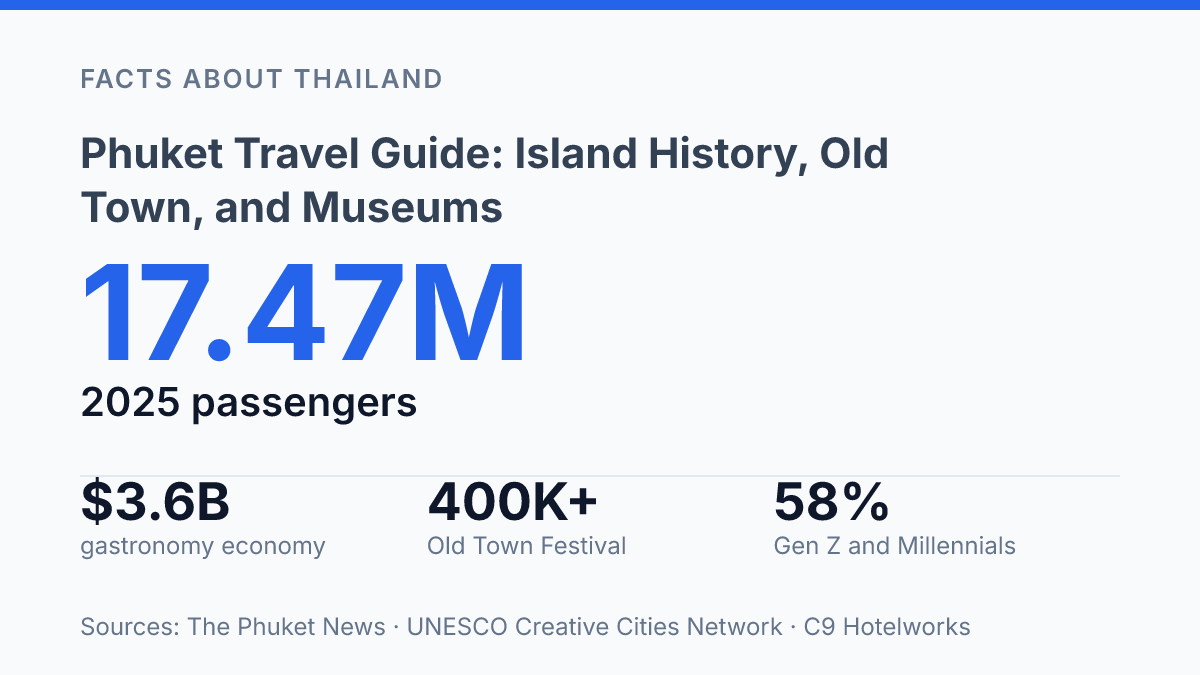
Phuket handled 17,474,064 passengers in 2025. The sharper story starts away from the beaches, inside streets built by tin money, Chinese migration, and old family trade. The airport nearly matched its 2019 peak, and travelers aged 18–44 now make up 58% of international arrivals.
That sounds like a resort machine. It isn’t only that.
The city works as the island’s memory bank. Buses, markets, shrines, museums, and cafés all pull toward its center. Thalang Road gets the photos. The better reward comes when you notice the covered walkways, tile floors, school plaques, and courtyards that survived commerce instead of escaping it. In my honest opinion, that tension is what makes the place worth more than a quick Sunday market stop.
This guide follows the city hub, the shophouse row, a 1903 mansion. The museum rooms that explain why the island looks, eats, and trades the way it does.
Why Phuket City is the island’s main hub
The island’s real control room is Phuket City, not the beaches that dominate most itineraries. It sits on Phuket Island and serves as the capital of Thailand’s Phuket Province.
When the province was formally set within the modern structure in 1977 after separating from the older administrative arrangement, the city gained a role the beach districts never needed to play. Government offices, courts, schools, hospitals, and local commerce concentrate here. The place works like an operating system for the island.
The scale behind that role is huge. According to The Phuket News, Phuket International Airport handled 106,581 flights and 17,474,064 passengers in 2025.
The total included 10,837,142 international passengers. Traffic reached 96.44% of the 2019 peak.
The main urban center isn’t serving a sleepy resort island. It’s helping absorb near-record movement.
That pressure is exactly why the city functions as the key administrative and transport center. Beach areas handle leisure well.
The capital handles orientation: bus links, errands, civic services, local food streets. The connections that turn one resort stay into a wider island trip.
Yet most visitors still treat it as a pause between airport, pier, and hotel. In my view, that’s the mistake, because the capital shows how the island actually functions when the sea view drops out of the frame.
Thalang Road and the Old Town shophouse row
A row of candy-colored facades on Thalang Road hides a harder truth: these buildings were made for trade, not postcards. The street is the clearest place to read the Old Town’s tin-era wealth in brick, plaster, shutters, and shaded walkways. For seeing Phuket’s heritage architecture in one concentrated view, this is the best-known street, not just another pretty lane in an old quarter.
Many of the Sino-Portuguese shophouses took shape in the 19th century, when mining money and Chinese migration reshaped the town’s commercial life. The layout tells you what mattered. Business happened at street level.
Families lived above. Covered front walkways gave customers shade and kept goods moving through heat and rain.
The style looks decorative now. It was practical first. Arched windows, timber shutters, narrow frontages, and deep interiors helped owners use expensive street-facing plots without wasting space. In my honest opinion, that practical intelligence is more interesting than the pastel paint, even if the paint is what stops most visitors first.
Look closely and the Chinese influence comes through in the building rhythm, household shrines, courtyard plans, and merchant-house logic. Portuguese and European details appear in the arches and stucco work. The street doesn’t feel copied from Europe.
It feels adapted. That mix is the point.
Old Town covers more than a single street. According to the provincial government, the heritage district spans 9 roads, including Rasada, Ranong, Pang-nga, Montri, Satoon, Yaowarat, and Thepkasatri. Still, Thalang Road carries the strongest visual impact because the shophouse row remains tight, continuous, and easy to read on foot.
The polished look can be misleading. Fresh paint and careful restoration make the street feel curated. The bones are commercial.
Tin merchants, migrant families, shopkeepers, and trade networks built this place. Tourism arrived later… and it’s only the latest use for a street that has always known how to sell.
Baan Chinpracha: a tin-era mansion with details that matter
The most revealing thing inside this mansion is underfoot: imported Italian tiles paid for by tin. That detail makes Baan Chinpracha feel less like a preserved house and more like a receipt from the island’s boom years.
The mansion was built in 1903 by Phrapitak Chinpracha, a wealthy tin merchant. His fortune came from an industry that did more than produce exports. It created a new class of merchant families with money, taste, and public weight.
Inside, the defining details are precise: Italian floor tiles, shuttered windows, and antique furniture. None of them feel accidental. The rooms show a family presenting itself as modern, educated, and connected to the wider world.
That elegance has a catch. The interior feels refined and European. The power behind it was local: tin money, family networks, and Chinese merchant status. In my humble opinion, that tension is what makes the house worth your time.
According to the 2026 Hotels Association heritage note, public admission is about 150 baht, and descendants still live on the upper floor. That small detail changes the visit.
You’re not walking through a sealed display case. You’re seeing a family home that still keeps one foot in private life.
Don’t rush the furniture. Look at how the heavy pieces sit against the patterned floor.
Watch how the shutters control light rather than simply decorate the walls. The house rewards slow looking, not checklist touring.
Thai Hua Museum and the story behind Phuket’s Chinese roots
The quieter building beside the showpiece house tells the bigger story. Set in a 1930s manor, Thai Hua Museum doesn’t try to impress through scale. It works because its rooms feel close to the lives it explains.
The building dates to 1934 and later served as a Chinese-language school until 2001, according to the Tourism Authority of Thailand Japan. That school history matters. A museum about migration, identity, language, food, and family memory lands harder inside a place once built for learning.
Compared with the grander house next door, the museum can look almost restrained. But that restraint is the point. In my view, this is the clearer stop if you want to understand why the island feels culturally mixed rather than simply old or pretty.
The permanent exhibition uses 16 rooms, according to Museum Thailand. The strongest sections focus on Chinese migration, the tin-mining era, Chinese education, local cuisine, and gallery displays.
That range keeps the story from becoming a single-topic heritage display. You see movement, labor, schooling, trade, and domestic culture as connected forces.
What makes the museum useful is its order. The exhibits turn ancestry into a timeline you can follow, not just a set of labels behind glass. Chinese heritage appears here as a working part of the island’s identity, shaped by migration and business, then carried forward through schools, festivals, kitchens, and family networks.
There’s a tradeoff, though. This isn’t the most theatrical heritage building in the neighborhood, and visitors chasing dramatic interiors may underrate it.
Stay with the text panels and room sequence anyway. The payoff is context: the museum explains the people behind the architecture you’ve already seen outside.
What the old streets ask you to notice next
Treat the old streets as a planning tool, not a postcard stop. Start early, then leave space for one slow room at Thai Hua Museum or one quiet courtyard before the Sunday crowd arrives.
The island’s food economy is worth US$3.6 billion a year, but heritage doesn’t survive on spending alone. It survives when visitors give attention to the people and places behind the meal.
That’s the practical next step for Phuket: choose fewer stops and read them better. A school founded in 1934, a mansion with descendants upstairs, a market that still sells dinner to locals… these aren’t props. In my humble opinion, they’re the evidence that travel gets richer when you stop treating culture as scenery.
Frequently Asked Questions
Q: What is Phuket City known for?
A: Phuket City is the capital of Phuket Province. That matters because it’s the island’s main historical and cultural hub. The Old Town stands out for its Sino-Portuguese shophouses. The area isn’t just pretty facades… it still carries the island’s tin-mining past.
Q: Is Phuket Old Town worth visiting?
A: Yes, especially if you care about history more than beach time. Thalang Road is the big draw, with colorful 19th-century shophouses and tight rows of Sino-Portuguese buildings that give the street real character. In my view, it’s the part of Phuket most visitors should see first.
Q: What can you see at Baan Chinpracha?
A: Baan Chinpracha was built in 1903 by a wealthy tin merchant. That alone tells you what kind of house it is. Inside, you’ll find Italian floor tiles, shuttered windows, and antique furniture. It feels lived-in, not staged, which makes it more interesting than a lot of grand old homes.
Q: What is the Thai Hua Museum about?
A: The Thai Hua Museum sits in a 1930s manor and focuses on Phuket’s culture and history. That mix of setting and subject works well, since the building itself adds context before you even read a label. If you want one museum that explains the island without making it feel dry, this is the one.
Q: How much time do you need for Phuket’s Old Town and museums?
A: A half day is enough for a solid first visit. A full day feels less rushed. You can walk Thalang Road, tour Baan Chinpracha, and spend time at the Thai Hua Museum without scrambling. The tradeoff is simple: short visits are easy. They leave out the details that make the area worth your time.