
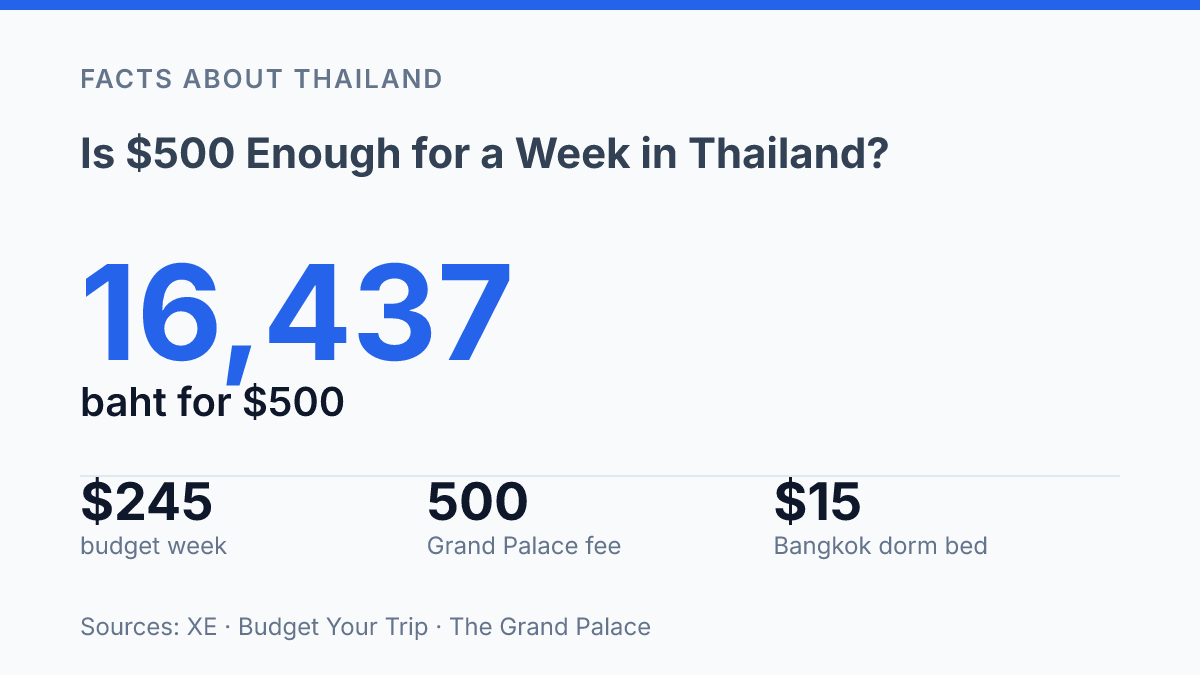
The answer to “Is $500 dollars enough for a week in Thailand?” starts with 16,436.83 baht, the September 9, 2026 XE mid-market equivalent before card spreads, ATM fees, or cash-exchange margins. Spread across seven days, that is about 2,348 baht per day, which places the trip in a narrow middle ground: above Budget Your Trip’s backpacker estimate of $245 per week, but below its typical solo traveler figure of $682. The budget is not judged only by Thailand’s low-cost reputation.
It changes sharply by location, with Bangkok hostel beds averaging about $15 a night while Phuket’s typical daily cost reaches $134. The real question is how much of the 16,437-baht pool survives accommodation, transport, sightseeing, island premiums, and avoidable transaction fees.
How far 500 dollars goes in one week
$500 leaves about 2,348 baht a day for everything on the ground, which is comfortable only if accommodation, food, and movement stay deliberately modest. On September 9, 2026, $500 equaled 16,436.83 Thai baht at XE’s mid-market rate of 32.8736 THB/USD, or about $71.43 per day before card fees, ATM charges, and exchange-rate spreads.
A workable seven-day frame would keep fixed daily costs low and preserve a buffer for admissions or short rides. One practical split is:
- Accommodation: 3,500–5,600 baht for hostel beds, basic guesthouses, or simple private rooms.
- Food: 1,700–2,800 baht if most meals come from street stalls, food courts, or casual local restaurants.
- Local transport: 700–1,500 baht using trains, local buses, songthaews, and occasional rideshares rather than frequent taxis.
- Basic sightseeing: 1,500–3,000 baht for temples, museums, viewpoints, and low-cost tours.
- Buffer: roughly 3,500–8,000 baht for laundry, SIM data, snacks, small mistakes, and price variation between cities.
Bangkok can fit this structure because cheap transport and a wide accommodation supply reduce daily pressure. Budget Your Trip puts Bangkok dorm beds at about $15 per night, with private hostel or guesthouse rooms around $20, while MRT rides fall in a low local range of 17–44 baht. A budget day using a dorm, street meals at roughly 50–80 baht, and public transport can sit near 1,300–1,900 baht, though major paid sights can raise that quickly.
Chiang Mai is usually easier on this budget because basic guesthouses, inexpensive meals, and short local rides tend to cost less than in Bangkok or the islands. A frugal day built around a 400–700 baht room, 40–70 baht local meals, and 30–60 baht shared red-truck rides can leave more room for temple fees, coffee, or a simple half-day activity.
Phuket is where the same $500 week becomes tight. Budget Your Trip estimates Phuket at $134, or 4,422 baht, per day for a typical traveler, while even its budget-traveler figure is $55, or 1,817 baht, per day. Beach-area rooms, longer taxi-style rides, drinks, tours, and nightlife can push spending above the 2,348-baht daily allowance quickly, so the budget is more realistic for a restrained week than for a resort-island holiday.
Where the budget stretches and where it breaks
A $500 week can look comfortable on paper until one resort-area hotel change, a domestic flight, or a packaged day tour absorbs the margin that cheaper meals were supposed to create. According to Budget Your Trip, a typical solo week in Thailand is estimated at $682 / 22,540 baht, while a budget-traveler estimate is much lower, at about $245 per week. That gap explains why the same country can feel either inexpensive or surprisingly tight: the budget works best when the trip follows backpacker patterns rather than standard holiday patterns.
Budget travel usually means shared rooms or simple guesthouses, street food and casual local restaurants, buses or trains where practical, and selective paid sightseeing. Mid-range travel changes the math because private rooms, ride-hailing, nicer beach areas, and more frequent paid attractions tend to appear together rather than one at a time. Comfort travel pushes well beyond the limit once air-conditioned boutique hotels, domestic flights, private transfers, beach clubs, spa visits, and guided excursions become normal daily choices.
Location is often the larger variable than food. Phuket, Koh Samui, and high-demand parts of Bangkok such as riverside hotel zones, Sukhumvit, and major nightlife or shopping districts tend to punish last-minute booking and preference for private rooms.
Island travel adds another layer because ferries, pier transfers, luggage handling, and weather-dependent route changes can create costs that do not exist on an inland city itinerary. Koh Phi Phi illustrates the pressure: Budget Your Trip puts its typical daily cost at $92, or $644 for a week, with even budget entertainment estimated at $18 per day, higher than its budget food estimate of $10.
The budget breaks most quickly when several premium choices stack together. A traveler who flies between regions, books a private room near the beach, joins guided snorkeling or elephant-related tours, and relies on taxis can exceed the weekly limit without eating expensively.
By contrast, a traveler staying in cheaper districts, moving slowly, and choosing only one or two paid excursions may remain within range. The practical lesson is that hotel location and transport style often decide the outcome before restaurant spending becomes the main issue.
Sample 7-day budget plan
A $500 week becomes much easier to control when the itinerary has one sleeping base and one low-cost day trip instead of multiple hotel changes. One realistic template is a six-night stay in Bangkok with local sightseeing and a day trip to Ayutthaya by public transport, keeping most costs predictable while leaving a small margin for ordinary travel friction.
A practical allocation can look like this:
- Accommodation: $165 for six nights in a basic hostel, guesthouse, or simple private room when booked early and outside peak pricing.
- Meals: $120 for casual Thai meals, market food, drinking water, and simple breakfasts rather than hotel restaurants or regular Western meals.
- Local transport: $55 for urban rail, buses, occasional short taxis, and public transport connected to the nearby day trip.
- Activities: $100 for temple admissions, museums, low-cost local experiences, and basic day-trip sightseeing rather than packaged premium tours.
- Buffer: $58 for laundry, mobile data, small tips, toiletries, price changes, or one unavoidable fee.
That sample comes to $498, which leaves almost no room for repeated splurges. The structure works because accommodation is capped first, meals are kept routine, and paid sightseeing is selected rather than stacked. A week could begin with arrival and low-cost neighborhood exploring, continue with two or three days of temples, markets, museums, and river or rail-based movement, include one Ayutthaya day trip, and finish with lower-cost walks, food courts, and free or inexpensive local sights.
The plan excludes international flights, visa-related costs where applicable, travel insurance, shopping, alcohol, nightlife spending, spa treatments, premium tours, and long-distance domestic flights. Those items are not minor add-ons on a tight weekly allowance; even one or two can erase the buffer and force cuts elsewhere.
A fixed plan is still only a planning tool, not a guarantee. Room rates can change sharply with season, events, booking timing, and neighborhood, while activity costs rise when paid attractions are grouped into the same day. The safest interpretation is that $500 can support a controlled city-based week, but the budget depends on holding the main categories close to the line rather than treating the total as flexible spending money.
Ways to keep costs under control
The easiest savings often come from avoiding one or two expensive decisions rather than cutting every meal or attraction to the minimum. Food is the clearest example: night markets and local food courts usually keep daily meal costs predictable, while cafés, hotel breakfasts, beach restaurants, and Western menus can push spending up without adding much logistical value. Choosing market meals also preserves variety, because rice dishes, noodle soups, grilled skewers, fruit, and snacks can be mixed across the day rather than relying on the cheapest single option available.
Transport discipline matters most in Bangkok, where BTS Skytrain and MRT trips can replace many taxis, app rides, and private transfers. Rail is especially useful when accommodation is near a station, because the saving is not only the fare but also the reduced risk of traffic delays leading to last-minute ride-hailing costs. For airport or intercity arrivals, shared vans, public rail links, and ordinary buses usually protect the budget better than door-to-door transfers, though they require more time and less luggage convenience.
Accommodation is where timing can change the same trip from manageable to strained. Booking guesthouses or hostel private rooms in advance is particularly important during high season, when better-located budget rooms sell out earlier and remaining rooms tend to be less central or more expensive. Low season can bring cheaper rooms and discounted tours, but rain, rougher sea conditions, or reduced schedules can make some beach and island plans less reliable, so the lower price is not always a simple win.
Cash handling is a smaller but measurable cost-control tool. Kasikornbank lists a 220-baht fee for international Visa or Mastercard withdrawals at its K-ATM machines, so repeated small withdrawals can quietly remove the price of a meal or local journey from the weekly total. Fewer withdrawals, paid accommodation where cards are accepted without surcharge, and a daily spending cap all make overruns easier to spot.
There is also a point where frugality reduces the trip itself. Skipping islands, private transfers, organized excursions, and spontaneous side trips can keep spending under control, but it also narrows the experience and lowers flexibility. A low-cost week works best when the itinerary is built around inexpensive cities, public transport, local food, and selective paid activities rather than trying to compress every high-cost highlight into one tight budget.
The small costs that decide the budget
A $500 Thailand week is less a single budget than a tolerance for small frictions. A 500-baht palace ticket, a 220-baht ATM fee, or a few taxi rides do not look decisive alone, but together they can move the trip from comfortable to restrictive.
The practical next step is to build the week in baht rather than dollars, fix the base destination before booking, and leave a visible reserve for transport gaps, fees, and paid sights. On this budget, Thailand is still accessible, but the itinerary has to behave like a budget traveler’s plan rather than an average vacation.
Frequently Asked Questions
Q: Can $500 cover a week in Thailand on a budget trip?
A: A $500 budget can cover a week in Thailand if spending stays modest, especially outside major tourist centres. The main limits are accommodation standard, intercity transport, and how often meals and activities are done in tourist-heavy areas. Travel style matters more than the headline amount.
Q: What are the biggest daily expenses for a week in Thailand?
A: Accommodation and transport usually take the largest share of a short trip budget, followed by food and activities. Costs rise quickly in popular islands and city centres, while local guesthouses and street food keep spending lower. Internal flights and private transfers can shift a budget above expectations fast.
Q: Is Thailand cheaper in Bangkok, Phuket, or Chiang Mai?
A: Costs vary by destination, with Chiang Mai often cheaper than Bangkok and Phuket typically among the more expensive options. Accommodation and transport prices are usually the clearest difference, while food can remain relatively affordable in many places. These differences can determine whether a $500 budget feels comfortable or tight.
Q: How much should be set aside for food in Thailand for one week?
A: Food costs depend heavily on where meals are purchased and the type of restaurant used. Street food and local eateries tend to keep daily spending low, while tourist-oriented restaurants raise the total quickly. A mixed approach usually gives the best balance between cost and variety.
Q: Does the $500 budget include flights to Thailand?
A: In most travel planning, a weekly budget such as $500 refers to spending inside Thailand rather than international airfare. Flights can be a major separate cost and may exceed the amount available for the trip itself. Separating airfare from on-the-ground spending gives a more realistic budget comparison.